H20 Formwork Beam
Timber I-beams for slab formwork: which profiles and lengths exist, what load they carry and whether it pays to rent them, buy new or buy used
Which formwork beam to choose
The profile follows the span between supports and the slab thickness
The H20 beam is the standard for slab formwork: prop fork heads and most kits are designed around it, so it is the beam most residential and commercial sites use. The taller H24 and H27 profiles span further under the same load, which means fewer props underneath. They are chosen for thick slabs and long spans.
H20, H24 and H27 compared
| Profile | Height | Load | Span | Best for |
|---|---|---|---|---|
| H20 | 200 mm | up to 35 kN/m | up to 3.0 m | Slab formwork in residential and public buildings, beam-based wall formwork |
| H24 | 240 mm | up to 42 kN/m | up to 4.0 m | Thicker slabs, wider prop spacing |
| H27 | 270 mm | up to 50 kN/m | up to 5.0 m | Long spans in industrial buildings and shopping centres |
Loads are for a single-span layout. We work out beam and prop spacing for your slab free of charge — we need the area, slab thickness and storey height.
Beam lengths
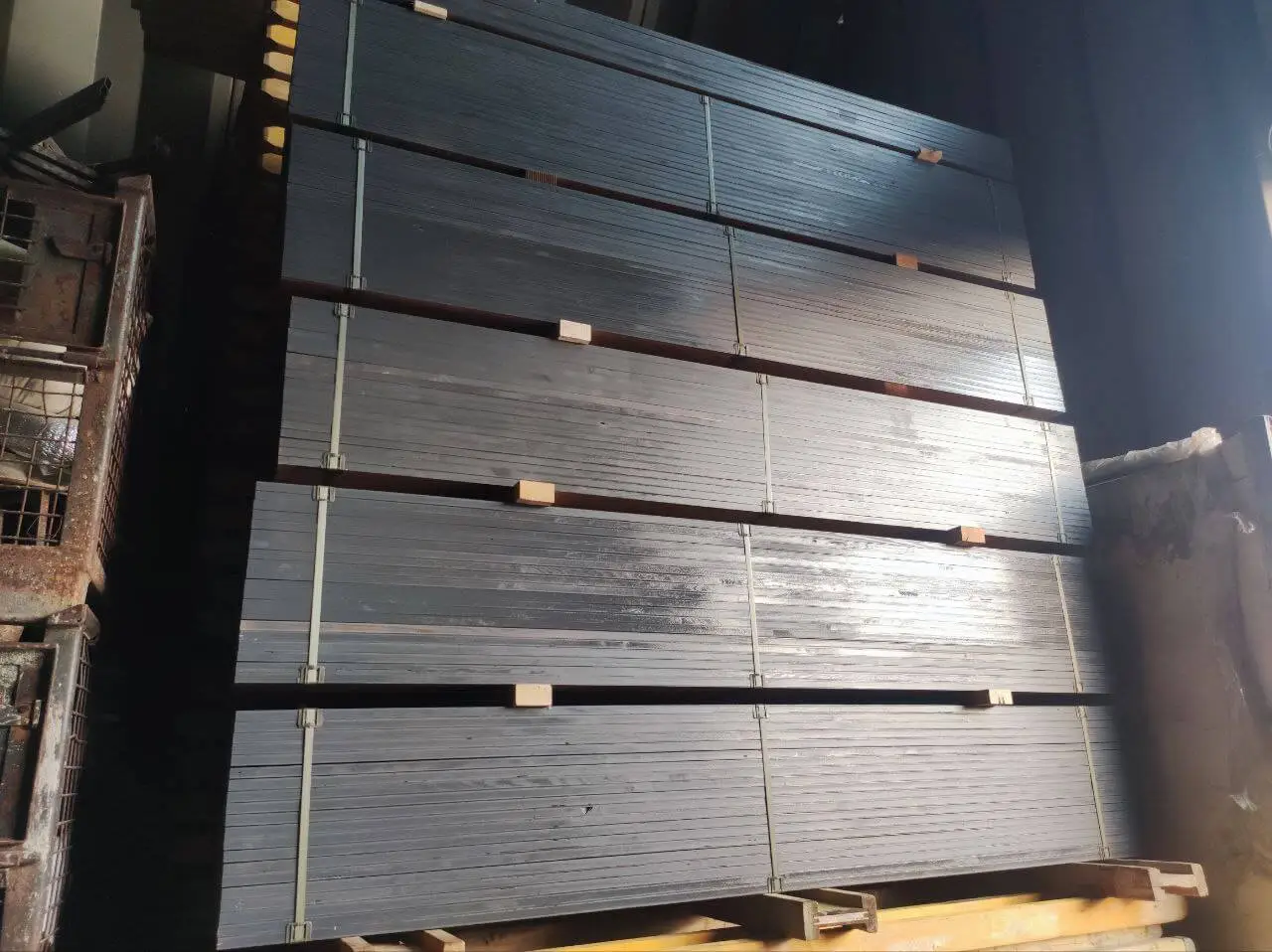
Beams are stocked from 2.0 to 6.0 m long. The most ordered lengths are 3.0, 3.6 and 4.0 m: two people can carry them, and they form a grid that fits most rooms.
- 2.0 m
- 2.5 m
- 3.0 mpopular
- 3.6 mpopular
- 4.0 mpopular
- 4.5 m
- 5.0 m
- 6.0 m
Long beams usually go in the lower (primary) layer, short ones fill in along walls and around columns. Non-standard lengths can be made to order.
How a timber I-beam is built
Why an I-profile rather than ordinary sawn timber
A formwork beam is a factory-made timber beam with an H-shaped (I-shaped) cross-section: two softwood flanges, top and bottom, joined by a web. The number in the name is the profile height in centimetres: H20 is 20 cm, H24 is 24 cm, H27 is 27 cm.
Flanges
The top and bottom flanges take the bending. Plywood rests on the top flange; the bottom flange sits in a prop fork head or on a beam of the lower layer.
Web
Joins the flanges and holds the profile height. The I-shape lets the beam carry a high load for its low weight.
Protected ends
The ends are fitted with metal caps that protect the timber from knocks during erection and unloading. Intact caps are one of the things we check on used beams.
Service life
Used properly, a beam lasts 10 years or more and moves from site to site. When you no longer need your beams, you can sell them to us.
Beam or sawn timber
Sawn timber of a similar size is heavier, warps and twists with moisture, and every piece differs slightly, so the formwork needs packing wedges. An I-beam keeps its shape, is identical across a batch and needs no trimming, so the slab comes out flat and the formwork goes up and comes down faster.
How beams work in slab formwork
A beam-and-prop system in six steps, from props to stripping
- 1
Props and tripods
Telescopic props are set to the storey height. The edge props are held by tripods so the system stands steady until the beams are placed.
- 2
Fork heads
A universal fork head goes into the top of each prop. The beam sits securely in it and cannot slide off during erection.
- 3
Primary beams
The lower layer of beams is laid in the fork heads, all in one direction. Prop spacing beneath them depends on the beam profile and slab thickness.
- 4
Secondary beams
The upper layer runs across the primary beams at 500 or 625 mm centres, so a 2500×1250 mm plywood sheet fits without offcuts and every joint lands on a beam.
- 5
Plywood
Film-faced plywood, 18–21 mm, is laid on the secondary beams and screwed down. Then the reinforcement is tied and the slab is poured.
- 6
Stripping
Once the concrete has gained strength, the props are lowered, the beams taken down, cleaned and stacked on bearers so they keep their shape for the next job.
H20 beams are also used in wall formwork, where they stand upright as the ribs of a panel and are tied together by walers on the outside.
What else you will need
Beam prices: rent, buy or sell back
Indicative prices. We quote the exact amount for your quantity, profile and length
| Option | Price | Terms |
|---|---|---|
| Formwork beam rental | from ₴22 per metre per month | Beams 3–6 m, 15-day minimum term, deposit 50–70% of the value |
| Buying new H20 beams | from ₴530 per running metre | Single beams, no minimum order; used beams and H24/H27 profiles are priced on request |
| We buy your beams | priced after inspection | The price is set after inspection and depends on condition, volume and demand; from 10 beams |
The price depends on the profile, length, condition and number of beams. Delivery within Kyiv costs from 700 UAH, elsewhere in Ukraine by quote; crane-truck unloading is included.
When to rent
One site and a short term. The minimum rental is 15 days, and after the pour you return the beams and don't have to store them.
When to buy
If you need formwork on several sites in a row. Used beams in ideal condition cost less than new ones and work almost the same.
When to sell
The build is finished and the beams are left over. We come to assess them within 24 hours, name the price after inspection and pay straight away.
Formex in Numbers
These numbers demonstrate our efficiency and achievements.
Formwork beam FAQ
Profiles, load, quantities and delivery in brief
No answer here? Tell us about your slab and we will match the beams
Call usAll Our Services
Rental, sale and buyback of formwork for construction
Formwork Rental
Formwork Sale
Formwork Buyback
We buy formwork of any type and condition. Fast appraisal, cash payment.
Sell FormworkKyiv. Bortnychi.
FORMEX LLC rents and sells formwork for monolithic construction.
info@formex.com.ua11 Bortnychi str. Lisova
Get directions